


Leopards are often described as elusive, but across the landscapes where we work, a more detailed understanding of leopard behaviour is beginning to emerge.
From the Mid-Zambezi ecosystem in Zimbabwe to the Chyulu Hills in southern Kenya, long-term monitoring and applied research are revealing how leopards move through different environments, how they use habitat, and how they persist in landscapes shared with people.
As a widespread territorial apex predator, the leopard (Panthera pardus) plays an important role in maintaining ecosystem balance. Their presence helps regulate prey populations, influences the behaviour of other species, and reflects the health and functionality of the systems they occupy. Because leopards are adaptable and can survive beyond protected areas, they are also a key indicator of how well-connected and resilient a landscape is.
Understanding leopard behaviour in these contexts is critical. It allows us to link movement patterns, habitat use, and prey availability to real conservation decisions, particularly in areas where human-wildlife interactions are increasing.
Building a Clearer Picture of Leopards and Large Carnivore Populations: Mid-Zambezi, Zimbabwe.
Research led by Great Plains Foundation Ecologist Thomas Mutonhori is examining leopard behaviour and movement patterns across the Mid-Zambezi ecosystem as part of his large-carnivore PhD study, which focuses on African wild dog translocations to Sapi Reserve.
By analysing diet overlap and spatial-temporal interactions among large predators, the work is revealing how leopards coexist within a system that includes lions, hyenas, and other carnivores. The research also looks at reproductive success and the environmental factors that influence breeding outcomes across the large-predator spectrum, helping define the habitat conditions needed to sustain stable populations.
Camera traps and scat analysis provide additional insight into population size, behaviour, and parasite loads, all contributing to more informed conservation decisions.
“This research informs conservation decisions by identifying key habitat metrics and landscape features, enabling us to mitigate human-leopard conflicts, particularly where leopards move beyond protected area boundaries… In the objectives of my PhD research, after determining the threats and habitat suitability, I would like to continue studying this carnivore guild as part of my postdoctoral research. This would also involve community engagement and the education of BSc students and the community in order to enable coexistence and teach future generations. Collaborating with relevant stakeholders will be crucial to securing the survival of these carnivore species.” Great Plains Foundation Ecologist, Thomas Mutonhori.
WHAT THE DATA SHOWS
A 2024 camera-trap survey conducted in collaboration with WildCRU confirms that leopards are widespread across the Mid-Zambezi ecosystem, with densities higher than those of most other large predators in the system, excluding spotted hyenas. The landscape itself supports this, a mix of riverine forests, grasslands, and woodlands, backed by mountainous terrain in the south that provides both cover and movement pathways.
“What’s striking is how adaptable leopards are – we have seen them moving through areas with human activity, showing they can coexist. It’s encouraging to see them thriving, but our work is far from over. We are seeing progress, and that’s what keeps us going.” – Great Plains Foundation Head of Foundation Zimbabwe, Gordon Duncan.
On the ground, our team and rangers are protecting this habitat and engaging communities to reduce conflicts. We are conducting educational programs in collaboration with Wildlife Conservation Action (WCA) to help locals understand leopard behaviour and promote good husbandry practices.

Sapi Reserve. Mid-Zambezi, Zimbabwe. Photographed by Great Plains Female Ranger, Olivia Marimira.
Leopard Behaviour in Kenya: Habitat, Movement, and Prey.
In Kenya, site-level monitoring is providing more detailed insights into how leopards use specific landscapes. Within a 75 km² study area, six individual leopards have been identified through camera trapping, establishing an important baseline for future, larger-scale studies.
The data highlights a strong association with lava flows, which appear to function as key movement corridors and hunting cover. These features provide structure within the landscape that leopards consistently use.
Prey availability is another important factor. Species such as bushbuck and dik-dik likely form a core prey base in the area, helping to explain observed distribution and activity patterns. Together, these findings link predator presence directly to habitat features and prey dynamics, a critical step in planning effective conservation strategies.
One of the interesting aspects of this work is the location. The Kenyan study area represents a functioning leopard population outside of Chyulu Hills National Park. This reinforces the importance of conservation efforts in shared landscapes such as the Amboseli-Tsavo region, where wildlife and people coexist. It also highlights the need for management approaches that go beyond protected boundaries in these regions, integrating habitat protection, monitoring, and community engagement.


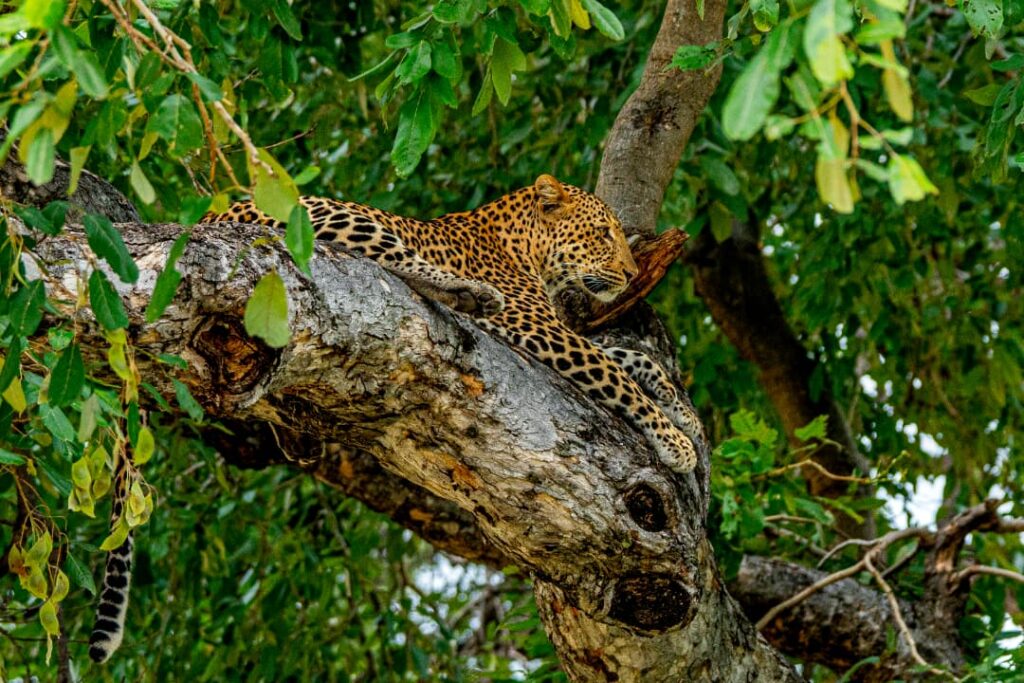
Leopard. Sapi Reserve. Mid Zambezi, Zimbabwe. Photographed by Female Ranger, Olivia Marimira.
Extending Understanding Beyond Our Core Landscapes
While our field research teams in Zimbabwe and Kenya are building a detailed picture of leopard behaviour, similar work is unfolding in other parts of Africa through the Great Plains Foundation’s Big Cats Initiative conservation partners.
In South Sudan, the Agency for Conservation and Development (ACD) is working in the Sudd, one of the largest tropical wetlands in the world, to better understand the presence and movement of large predators, including leopards.
Using camera traps and field surveys, their work has helped confirm the presence of big cats in and around the Zeraf Game Reserve. In a landscape where baseline data has historically been limited, this kind of evidence is essential. It provides a starting point for understanding leopard behaviour, distribution, and how these animals use the landscape.
What makes this work particularly important is its connection to people. Alongside monitoring, ACD is engaging with local communities to reduce retaliatory and culturally driven killings of predators. By linking emerging data on leopard behaviour with practical coexistence strategies, the work supports both species protection and community resilience.
Taken together, these efforts reflect a broader approach to conservation, one that recognises that understanding leopard behaviour must extend beyond well-studied areas and into landscapes where data, support, and visibility are still growing.
ADAPTABILITY AND COEXISTENCE
Across regions, a consistent theme is adaptability. Leopards are moving through areas with human activity, adjusting their behaviour and making use of available cover. This flexibility allows them to persist, but it also brings them into closer contact with people. To address this, teams are working with communities to improve understanding of wildlife behaviour and promote practices that reduce conflict.
This work aims to understand leopard behaviour and apply that understanding through conservation initiatives.
By linking predator presence to habitat features and prey availability, and by tracking how leopards move across landscapes, we are better positioned to:
- reduce human-wildlife conflict
- protect key habitat features
- support long-term population stability
Leopards remain a constant presence across these systems.
Maintaining their populations requires continued monitoring, strong partnerships, and evidence-based decisions. This is where long-term conservation remains critical to gain further insights and to protect this iconic and ecologically critical species across Africa.
 A special thank you to all our implementing partners, Big Cats Initiative donors, supporters, Earth Partners, and donors who are part of this mission to protect big cats around the globe. If you would like to learn more or support these efforts, please get in touch at info@greatplainsfoundation.com or visit our donate page.
